
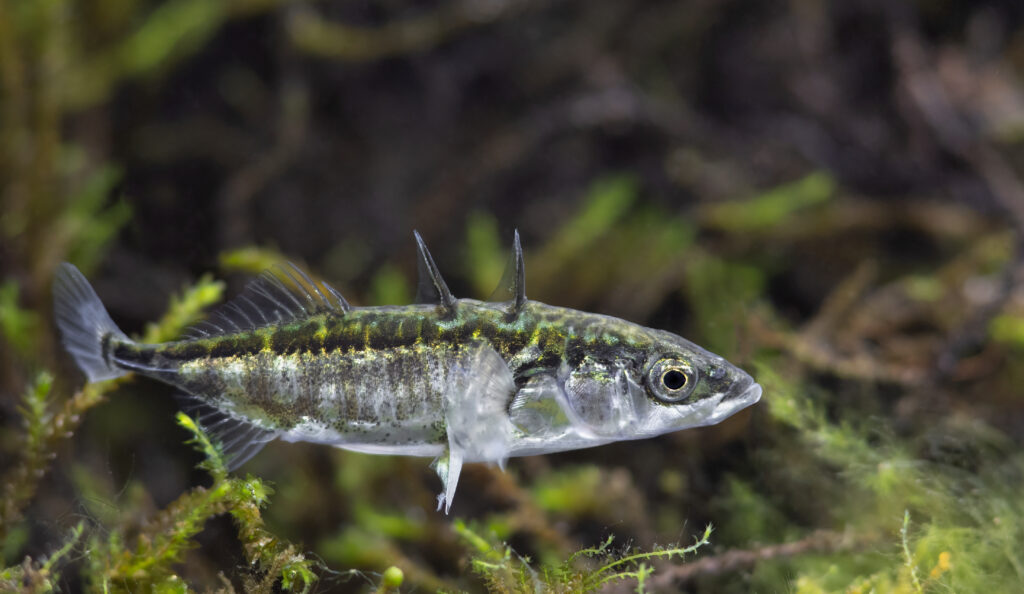
New article: “Juvenile and Adult Three-Spined Sticklebacks Exhibit Different Habitat Use in Shallow Baltic Sea Bays”
The three-spined stickleback prioritises different environmental factors at various stages of its development. While young three-spined stickleback are more commonly found in various types of vegetation, older three-spined stickleback appear to prioritise access to invertebrate prey. This is shown in a new article—co-funded by Blue Food—by doctoral student Chiara D’Agata, Uppsala University and Thomas Staveley, SLU.
The study was conducted in shallow Baltic Sea bays by counting three-spined sticklebacks and other fish of various sizes to determine their abundance in relation to various environmental factors. Where there was more vegetation of various types, there were also more young three-spined sticklebacks, even when the availability of prey was lower. For older three-spined sticklebacks, there was no correlation with vegetation; however, they were more likely to be found in areas with more prey.
In recent decades, the abundance of stickleback has increased significantly in the Baltic Sea, at the expense of predatory fish such as pike and perch. Much is known about the stickleback, but there are still gaps in our knowledge, including how it utilises different habitats. The current study helps to fill that knowledge gap and is part of Chiara D’Agata’s doctoral thesis, which she will defend on 28 August this year.